Automation Engineering — Systems Portfolio
Engineering resilient automation systems for operational workflows.
I design and operate self-hosted n8n infrastructure that ingests, scores, and routes business leads without manual intervention — built for small and mid-size service businesses where reliability matters more than feature count.
Operational Overhead
−73%
Manual lead triage hours eliminated through scoring and routing automation.
Average Processing Latency
<2.1s
End-to-end time from inbound payload to CRM record and alert dispatch.
Payload Accuracy
99.6%
Validated field-level accuracy across scoring engine inputs in production logs.
Deployment Console
leadpulse-pipelineCommit
a3f12c9
Build
#0142
Runtime
n8n 1.6x · Docker
Deployed
2026-06-14 09:42 PT
System Architecture
Each workflow is loosely coupled and addressed through sub-workflow execution rather than direct HTTP triggers, which keeps failure domains isolated and makes individual stages independently testable and replaceable.
Reliability
A global error handler (WF-E) catches failures across every workflow and routes them to a single alerting path.
Observability
Telegram alerts are MarkdownV2-escaped and structured, so failures and high-value leads surface immediately without log diving.
Scalability
Sub-workflow execution replaces webhook chaining, allowing stages to scale or be replaced without breaking upstream callers.
Maintainability
Airtable field keys follow a consistent spaced-key convention, reducing mapping errors across workflow boundaries.
Pipeline — WF-1 through WF-3
Project — Deployment Report
ProductionLeadPulse — Automated Lead Generation Pipeline
n8n · Airtable · Telegram Bot API · GitHub Pages · DigitalOcean
Problem
Small service businesses receive inbound leads through a web form with no consistent way to prioritize them, leading to delayed follow-up and inconsistent qualification.
Architecture
Four workflows (WF-0 through WF-3) plus a global error handler (WF-E), self-hosted on a DigitalOcean droplet via Docker Compose with Caddy handling TLS termination.
Business Impact
Replaces manual lead review with a 100-point scoring engine across four pillars, cutting triage time and surfacing high-intent leads to the team through Telegram in real time.
Deployment Status
Live in production. Monitored through a Google Sheets–backed dashboard (LeadPulse) with auto-refresh and filterable lead views for non-technical stakeholders.
System Architecture
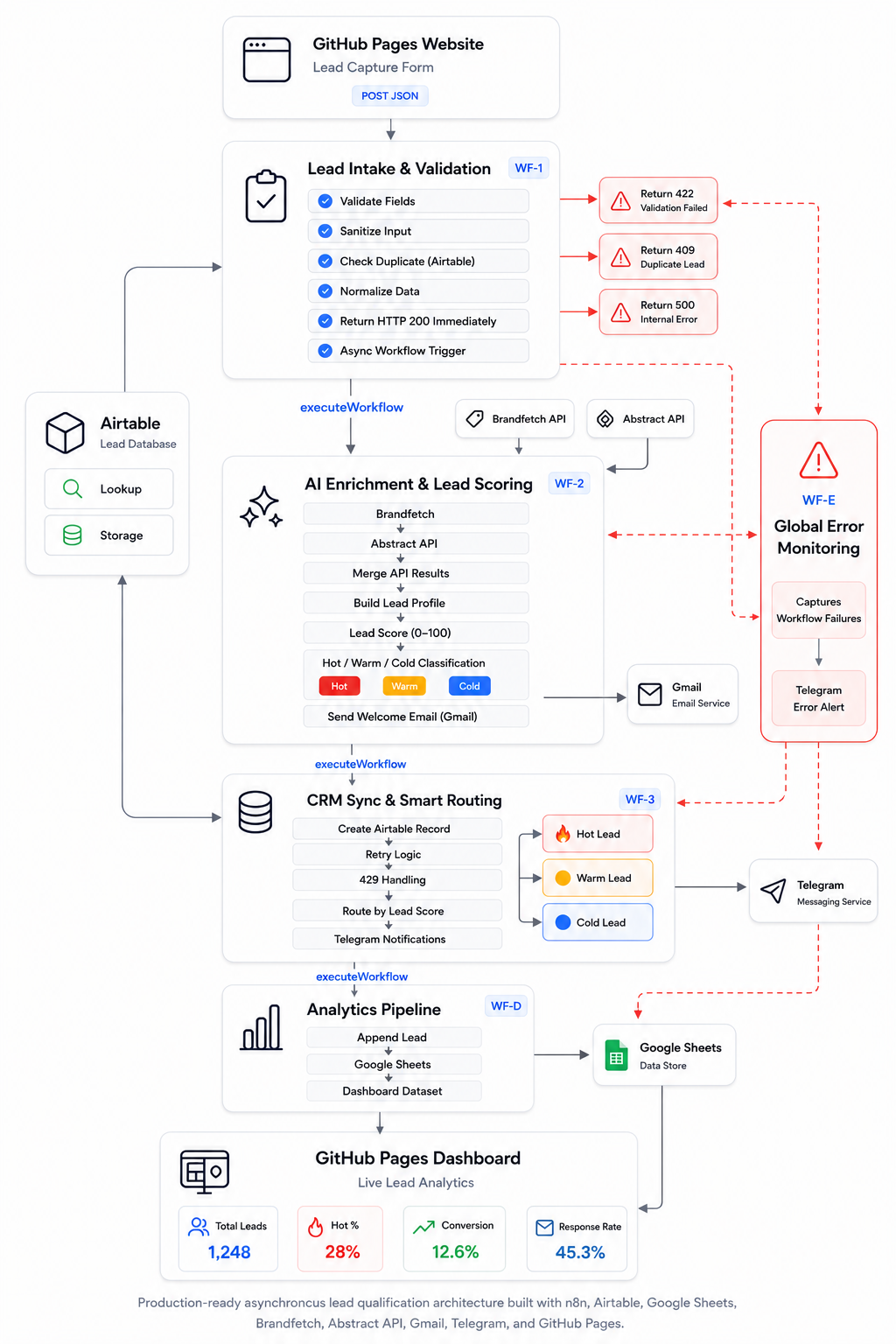
Five-workflow pipeline: intake validation → AI enrichment & scoring → CRM sync → Telegram delivery → global error handler
Technology Directory
Automation
Infrastructure
APIs & Data
Version Control
Engineering Principles
Reliability
Every workflow assumes failure is possible and routes errors to a single, observable path rather than failing silently.
Systems Thinking
Stages are decomposed into independently testable workflows connected through explicit, documented contracts.
Operational Visibility
Stakeholders see system state through a live dashboard rather than waiting on status updates or manual reports.
Maintainability
Naming conventions and field keys are kept consistent across systems so future changes don't require relearning the codebase.